STATION 3

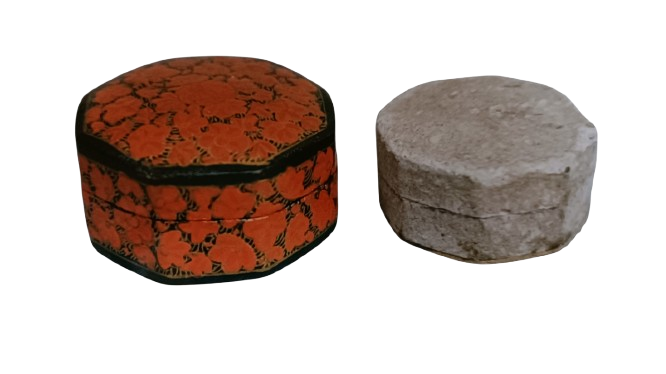
You have reached the last stop – the souvenir shop inside the Völkerkundemuseum. Here, you find small boxes, keepsakes from your journey, for sale. But what do they hold inside?

STATION 3
The paper machee box from Kashmir reminds me of my first travel to India in 1986. I took my 2-year old son and travelled there, not knowing what would await me. I was welcomed by a big family of boat house owners, who immediately ‘adopted’ me and my son when we arrived, and made us part of the family. I then learned how to paint the paper machee items that were produced there, while my son played with the kids of the family. I wonder whether I still could paint these fine roses?
They bring about the scenes of craftsmen, with their old hands beautifully carving these little boxes.
The grey oval-shaped box intrigues me the most. Both in terms of time and space it is challenging to locate, at least for me. I imagine this is a box a middle-class or upper-middle-class woman would use to keep her jewellery (in the mid to late 19th or early 20th centuries)
This beautifully carved white or soapstone oval box with floral lattice evokes a quieter kind of memory—delicate, sensory, hidden.
The Scent of Sandalwood
There was a box like this in my mother’s almirah, tucked beneath layers of old sarees and mothballs. It wasn’t opened often—but when it was, it filled the room with sandalwood and secrets.
Inside were earrings missing their pair, a bottle of attar with a rusted lid, a betel leaf folded into a triangle, and a note—faded blue ink—written by someone I was not supposed to ask about.
I remember running my fingers along the carvings, tracing flowers I didn’t know the names of. The stone was always cool. It felt like silence—intentional, composed, unbothered by time.
Now I see this box in the museum and wonder: does anyone else smell sandalwood when they look at it?
The larger boxes were often family treasures, bought to store gold and other ornaments. The smaller ones though, were mostly reserved for vermillion to offer to guests would leaving the house. Once in a while we’d store sweets in empty silverware to feel fancy!
My mother had a similar box, though it wasn’t hers. It belonged to a close friend who had migrated to Canada years ago. He had been orphaned in India and raised by my grandparents, growing up like a brother to her. Perhaps that’s why she held on to so many of his things long after he left—a handwritten cookbook (he later became a chef), a bundle of old documents, a worn telephone book filled with birthdays and contacts, and this box, which held passport photos of his parents.
STATION 3
The two octagon shaped boxes reminds me of porcelain and lacquer ware of East Asia. The red and black colour is especially common in lacquer decoration, while white ware was something popular in North East Asia.
These were usually “showpieces” in the drawing room but my most immediate memory is catsitting for a friend in Frankfurt and finding weed in one of them.
The two engraved boxes look a lot like the box i use to store jewelry. They often carry a very significant woody smell and the one i have has a red almost carpet like base to it.
I remember my mother having a few of them, though the exact details of their design have blurred over time. What I cannot forget, however, is a particular incident from my childhood.
It was sometime around 2007 or 2008, when I was in the second grade. We had gone to visit my grandparents for a family wedding, and my mother had carried her jewellery in a couple of beautifully handcrafted boxes passed down to her from my grandmother. One afternoon, while my parents and grandparents were out shopping for wedding gifts, I stayed back at home. Restless and mischievous as always, I soon grew bored of the television and began looking for something to entertain myself.
I had a fascination for my mother’s jewellery. She often dressed me up with it for fun and took pictures, and I loved admiring myself in the mirror. That day, I decided to do it on my own. But in the process of rummaging through the boxes, I dropped one. It hit the floor, the hinges broke, and the lid cracked. Terrified, I tried to hide it on top of a cupboard, hoping it wouldn’t be discovered.
When my parents returned, it didn’t take long for them to notice. I was called into my room by my father, my heart pounding, expecting scolding and punishment. Instead, what I walked into has stayed with me ever since: my mother in tears, being consoled by my father. In that moment, I understood the deep sentimental value those boxes carried for her. I couldn’t deny what I had done. I did get punished, but what stayed with me was not the punishment—it’s the memory of my mother’s grief over something so precious to her.
The grey object reminds me of something that used to be in our kitchen for crushing some items.
The embroidered wooden chest carries so many memories. My mother’s chest has a red carpet-y lining inside, usually she keeps her gold bangles and earrings in it, and it always smells like flowery talcum powder whenever I opened it – probably because it was kept on the dressing table. Sometimes I would find some tiny moisturising cream cases in it as well. The dressing table light was always a bright white bulb and I find it very cold, hence I found it in complete contrast to the design and emotions the chest invoked in me. I know my own home will only have yellow lamps so these chests will find the right place (for me) in the future 🙂